Buying a gown to transform it does not automatically make the transformation cheaper.
It is one of the most common assumptions we hear in consultations, and it is easy to understand why. A bride finds a dress she loves for its fabric, or its silhouette, or its price. She pictures it as a starting point. Change the neckline, rebuild the bodice, add sleeves, and arrive at something no one else will be wearing.
I tell brides this often: the dream gown that just needs a little something can quickly turn into a nightmare if it turns out to need a whole lot of something else.
That instinct is often right. Some of the most beautiful gowns that leave this studio began as something else entirely.
But the purchase price of the foundation gown tells you almost nothing about what the transformation will cost. What determines that is the construction hiding inside it.
A Restyle Is Not an Alteration
Alterations work within a gown’s existing structure. Take in a side seam. Shorten a hem. Adjust a strap. The architecture of the dress stays exactly as the designer built it.
A transformation changes that architecture.
When we restyle a gown, we are working with its seam placement, its internal corsetry, its lining, its boning, the grain of the fabric, and the proportions the original designer chose. Those elements were engineered to produce one specific silhouette. Asking them to produce a different one is a structural question, not a cosmetic one.
That is the distinction that surprises brides most. A restyle is closer to redesigning a garment than to adjusting one. Off-the-rack becomes custom made, balanced, and for you only. You can see what that work involves on our wedding dress alteration and transformations page.
Someone you know may sew and offer to do it for less. My question is always the same: do they sew professionally for a living?
What Determines the Cost of a Transformation
The price of a bridal transformation comes down to how much of the original gown can stay, and how much has to be rebuilt.
- Seam placement. Every seam in a gown is a decision. If the new design needs seams where the original has none, or needs none where the original has several, that fabric has to be taken apart and reassembled.
- The internal structure. Most well-made gowns carry a foundation you never see: corsetry, boning, a lining built to hold a specific shape. Change the silhouette and that foundation often has to be rebuilt from the inside out.
- Size difference. A gown several sizes away from your measurements does not simply get taken in. Grading a dress across multiple sizes moves every seam, redistributes the fabric, and frequently means reconstructing the bodice entirely.
- Fabric behavior. Silk charmeuse, structured mikado, and delicate tulle all respond differently to being opened up and reshaped. Some fabrics forgive it. Some show every previous stitch line permanently.
- Specialty detail. Feathers, fringe, dimensional appliqué, beading, custom draping. These are hand-applied, one at a time, and the labor is real. A heavily embellished addition can take longer than the reconstruction it sits on.
None of those factors care what you paid for the dress.
Why Some Restyles Cost Less and Others Cost More
A well-chosen foundation gown can save substantial work. If its silhouette is close to your vision, its size is near your measurements, and its internal structure supports the new design, you are ahead. You have skipped the pattern work and much of the construction. That is a real advantage and a real savings.
A poorly chosen foundation gown creates work that would not otherwise exist. If we have to deconstruct a bodice to rebuild it, remove embellishment to reach a seam, or grade a gown across four sizes before the design work even begins, you are now paying for reconstruction and for the new design. Moving walls while we are building your house defeats the purpose of creating a custom fit.
In some cases, a bride has spent money on a dress that makes her vision more expensive to achieve, not less. And yes, the transformation may cost more than the original gown.
That is the outcome we would like to help you avoid.
Consult Before You Buy
This is the most practical advice in this article: if you are considering a significant transformation, talk to us before you purchase the foundation gown.
A consultation before the purchase lets us look at silhouette, size, and construction together, and tell you honestly whether that particular dress is a good starting point for what you have in mind. Sometimes the answer is yes. Sometimes we can point you toward a different silhouette that will get you to the same finished look with far less reconstruction.
That conversation routinely changes the budget of the entire project.
Once the gown is purchased, our options narrow to what that dress will allow.
What a Transformation Looks Like in Practice
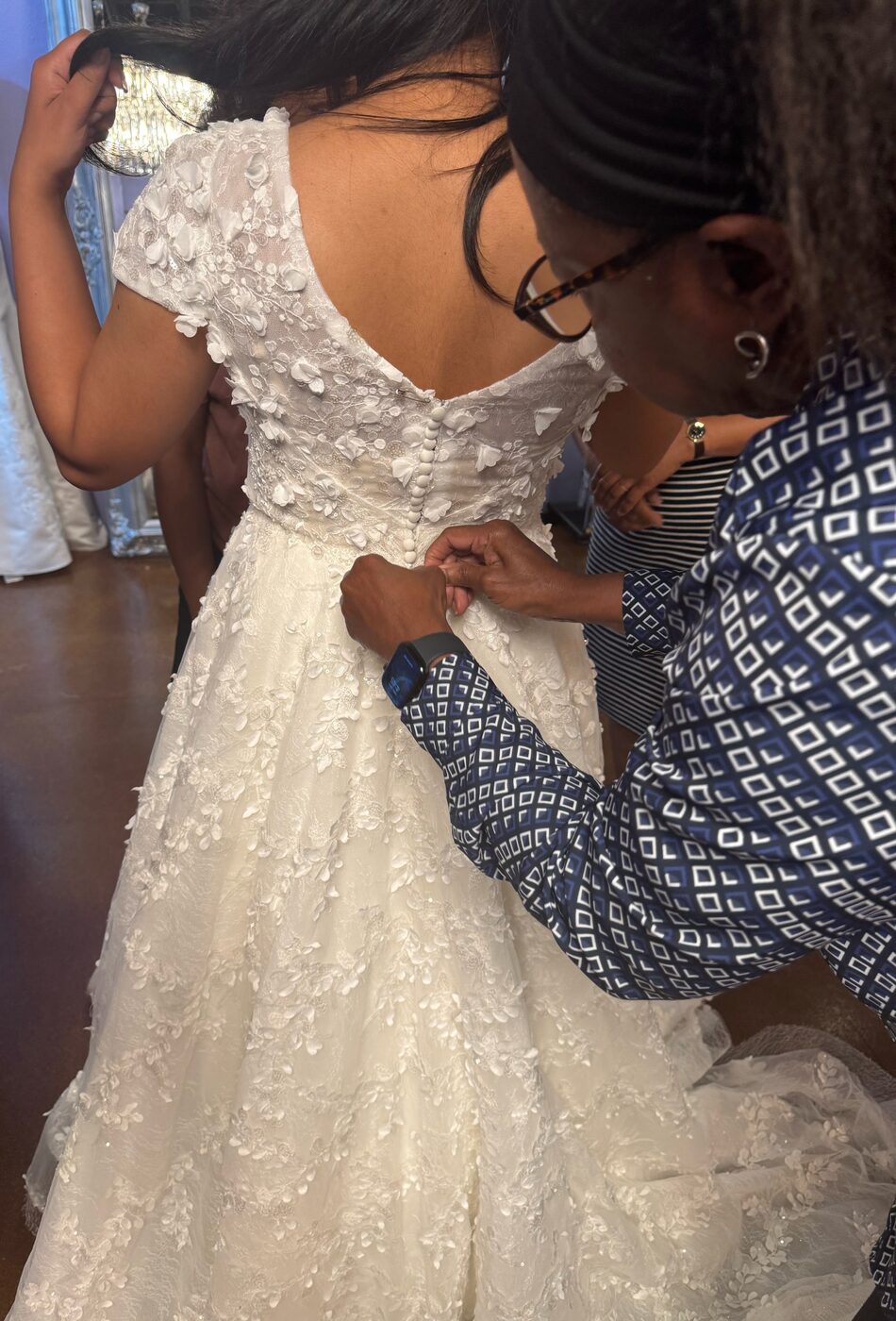
A transformation begins with an assessment, not a quote. We open the gown up, figuratively at first, and look at what is actually inside it. Seams, structure, fabric, allowance. How much of this foundation can carry the new design.
From there we can tell you what is possible, what is possible but costly, and what would be better achieved another way. Brides are sometimes surprised by which is which. Adding sleeves to a strapless gown is often straightforward. Moving a waistline two inches can mean rebuilding the entire bodice.
Then the work begins: pattern, structure, fittings, refinement. Multiple fittings, always. A transformation is not finished when the new design is attached. It is finished when it fits as though the gown were made that way.
I often get asked why it takes so long. This is why. We also book up fast, so start early.
Bringing a Restyle to Margo West
Dallas brides come to us with gowns from every source. Boutique purchases, sample sales, online finds, and gowns that have been in the family for forty years. We evaluate each one the same way: what is inside it, and what will it take to get where you want to go.
What we will not do is quote a transformation without understanding the garment, or promise a silhouette the construction cannot support.
A beautiful restyle is not about making an old dress look different. It is about seeing what is possible inside a particular gown, and being honest about what it will take to get there.
Every bride has her own unique style. We tailor a plan for each bride, exclusively, for the best possible outcome.
Schedule your Dallas bridal consultation with Margo West, or call us at (972) 918-9750, and let’s look at your gown together, ideally before you buy it.
Frequently Asked Questions
Is restyling a wedding gown cheaper than buying a new one?
Sometimes. It depends entirely on how much reconstruction the design requires. A restyle that works with the gown’s existing structure can cost considerably less than a custom gown. A restyle that requires rebuilding the bodice, regrading the size, and adding specialty detail can approach or exceed it.
Should I buy the gown before my consultation?
We recommend consulting first whenever possible. Evaluating silhouette, size, and construction before purchase is the single most effective way to control the cost of a transformation.
How many sizes can a wedding dress be altered?
There is no fixed number. It depends on the gown’s construction, seam allowance, and how the fabric behaves. Some gowns can move two or three sizes cleanly. Others cannot move one without reconstruction. This is why the gown itself has to be assessed.
Can any wedding dress be transformed?
No. Some constructions will not support a significant redesign, and some fabrics will not recover from being taken apart. Part of our job is telling you that before you have invested in the attempt.
How long does a bridal transformation take?
Significantly longer than standard alterations. Major transformations should begin several months before the wedding date, and complex work benefits from more time than that.